
The Croze Line
A Family History in Art, Glass, and Light
In the latter half of the nineteenth century, a young couple left Lithuania and emigrated to the United States, settling in Brockton, Massachusetts. Their daughter, Isabel, would go on to marry a man named Harvey Croze, whose own father, Eusebe, had come south from Quebec, where he kept a saloon. These ordinary beginnings, a saloon-keeper from Canada and the daughter of Lithuanian immigrants, would set in motion a creative lineage that would eventually stretch across seven countries, five generations, and nearly every medium a human hand can work in.
Meanwhile, in Königsberg, the ancient Prussian city on the Baltic, another lineage was building. Gertrude Pfeiffer became the first woman admitted to the city’s famed art academy. She painted vast landscape murals on commission for the German Geographical Society and illustrated children’s books. Her husband specialised in portraits and decorative painting, including the gilding of churches. Their son Hans Ludwig Pfeiffer became a sculptor. And their daughter Riccarda became a brilliant artist in her own right, though the world she was born into forced her to exhibit under the male pseudonym “Ralph Gregor” to be taken seriously. These two families, one in America and one in Germany, would not intersect for decades. But when they did, the result would be extraordinary.
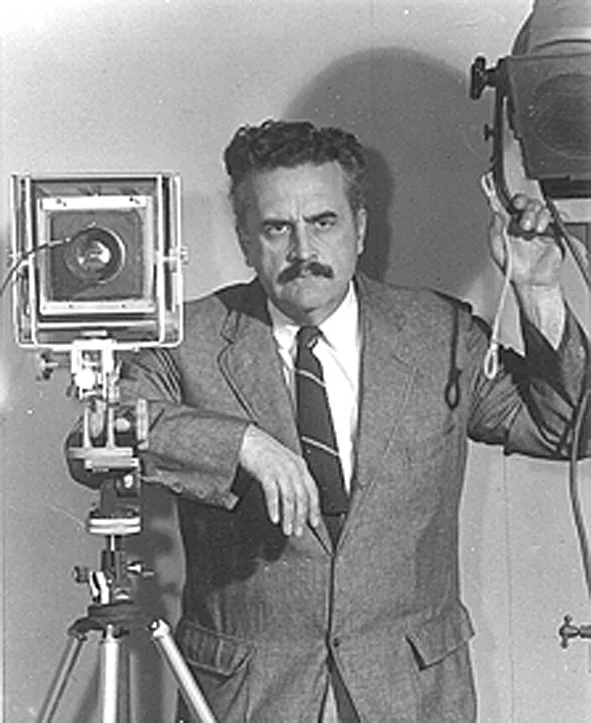
Harvey Croze Senior was born in Houghton, Michigan, in 1904, in the state’s Upper Peninsula. He was a big man with a big black moustache and an appetite for everything. He was a competitive swimmer who tried out for the 1938 Olympic team and nearly made it. He was an actor in Detroit theatre groups. He bossed a battalion of harvesters for a West Indian sugar company. And then, somewhere in the early 1940s, he decided photography would be a sweeter profession than any of them.
He started in the dark, literally. He got a job as an apprentice darkroom worker at Chrysler, then moved to General Motors. “I wanted to learn it from the hypo pan up to the lens,” he said later. He started taking lessons from the world-famous photographer Ansel Adams in Detroit. He studied further at the Chicago Institute of Design and under Nicholas Haz in New York. In 1942, photographers from all parts of the world were looking enviously at this newcomer making waves in the international salon circuit, the network of juried photographic exhibitions that served as the main pathway to recognition for serious photographers before the gallery system took hold. And in 1943, a year after his son Harvey was born, he landed the position that would define his career: Photographer in Residence at the Cranbrook Foundation in Bloomfield Hills, Michigan.
Cranbrook was not just a school. It was one of the most important creative institutions of the twentieth century. Designed by the Finnish-American architect Eliel Saarinen, who served as its first president, the campus was a total work of art: the buildings, the furniture, the textiles, the metalwork, all conceived as a unified vision. The Swedish sculptor Carl Milles ran the sculpture department from 1931 to 1951, and his monumental bronze figures were scattered across the grounds like a permanent open air gallery. Frank Lloyd Wright’s architecture stood nearby. Charles and Ray Eames studied there. Florence Knoll studied there. The institution was a crucible of midcentury design, and Harvey Croze Senior was its resident photographer for twenty seven years.
He documented everything. Sports events and art exhibitions. Plays, concerts, class photos, and graduation portraits. He loved what he did and did what he liked, creating beautiful images well beyond the workday requirements of the institution. His fascination with form and figures, faces, light and shadow, texture and technique is evident in the portfolio of black and white salon prints he produced over those decades. He shot on a 4x5 Speed Graphic in his early days, the press photographer’s camera of choice, a large-format beast that demanded precision. Later he moved to a Rolleiflex, the elegant twin-lens medium-format camera that looked down into the world from waist height. And eventually he adopted the Leica, the 35mm rangefinder that had revolutionised photography since the 1930s. His progression through those three cameras mirrors the entire evolution of twentieth-century photography.
But Harvey Senior was not just a photographer. He was a man who could not sit still. He painted in oil and acrylic. He made jewellery from silver, copper wire, and bits of plastic. He built a frame and produced silkscreen prints, mainly of fanciful fish. He went through a period of songwriting, during which his habitual early-morning wandering would take him downstairs to a little four-octave foot-pedal organ on which he tapped out and transcribed tunes that had come to him in the night. He loved gadgets as much as the rest of the Croze males. In the early 1950s, the family got one of the first Motorola televisions, black and white with a five-inch screen. He had the only wire recorder his son ever saw. He devised a simple pulley system that allowed him to turn down the television volume during commercials without having to stir from his Charles Eames chair. He produced and directed a short movie based on the life of Christ. He collected things that might come in useful one day.
His wife Isabel worked alongside him at Cranbrook as his administrator and photo retoucher. Their son, Harvey, grew up on the campus, biking around Milles sculptures and playing beneath Saarinen’s architecture. He did his homework in his father’s studio after school, and frequently wandered into the darkroom to watch the magic unfold. “I can still smell the hypo,” he would write, decades later. “You might say I am made from photography: it fed me, clothed me, educated me.”
Harvey Senior’s work travelled the world. He exhibited at the New York World’s Fair in 1940, then in Dunedin, New Zealand; Whitby in the United Kingdom; the Western Ontario Salon in Canada; the Denmark International Photo Exhibition; the Pacific National Exhibit in Vancouver; and the Smithsonian Institution in Washington DC. At the Smithsonian, in January and February of 1957, he was given a solo exhibition in the Northwest Gallery under the banner “Pictorial Photographs by Harvey Croze, Section of Photography.” A photograph from the exhibition shows a visitor standing before his prints, the placard bearing his name mounted on the gallery wall beside a row of framed images stretching into the distance.
He won awards across the globe: the Graphlex Golden Anniversary Merit Award and the San Francisco International Color Award, both in 1945, an annual award from the Michigan Academy of Sciences, Arts and Letters, an International Gold Medal in São Paulo, Brazil in 1950, a Photographic Society of America Hourani Award in 1951, a Zeiss International Award in 1955, and a Silver Medal from the Greater Detroit Camera Club Council in 1957, among others. His wife Isabel wrote on the back of one of his press cuttings: “Harvey was very ahead of his time as a photographer and fought any and all to prove ‘Photography as Art’. Now I understand the museums all around the world have come to accept this premise and collect fine photographs.”
He considered himself a pictorialist. “Photography, regardless of whether contemporary or pictorial, is the art of our time,” he told the Detroit News, circa 1960. “The art of the masses.” He taught photography to students at Cranbrook, stressing the importance of creating individuality. “Burn up plenty of film,” he would tell them. “Originality, he believes, is the most important quality in a photographer after he has learned how to use the many tools now available to him.” Harvey Croze Senior retired from Cranbrook in 1970. He died in Harrison, Michigan in 1978. His negatives and prints have since been sequestered by the Cranbrook Foundation and Art Academy.
His son, Harvey, took a different path, though it led him, eventually, back to the camera. He graduated from Cranbrook School, then Amherst College, then Oxford University, where he earned a DPhil in animal behaviour. His first professional posting was as elephant ecologist in the Serengeti National Park in Tanzania in the late 1960s, studying the interaction between elephants and the woodlands. Around this time, Harvey married Nani.
Nani’s story begins in the rubble of a city that no longer exists. She was born in Königsberg around 1943, into the long artistic lineage of the Pfeiffer family. When she was two years old, the Red Army invaded. Königsberg, already in rubble from Allied bombing, was overrun. Nani and her mother Riccarda fled. They hid on a cargo train, scrambling into a carriage and burying themselves under hay. Drunken Russian soldiers laughed raucously in the carriage next to theirs. Riccarda gave the infant Nani a muslin bag of black tea to suck on so she would keep quiet. They made it out.
They ended up at an artists’ commune on the Usedom Peninsula on the Baltic Sea, where Riccarda’s friends took them in. There was no money, no food, hardly anything. Riccarda was suffering from tuberculosis. They lived in a tiny cottage on a small rise, surviving on potato skins collected from a neighbouring farmer and skimmed milk. When Nani’s friends came to play and asked for food, Riccarda would tell them to drink water from a bucket by the door. She later remembered the first banana she ever ate. It was given to her by an American soldier who laughed at her because she didn’t know that she had to peel it.
After the war, Riccarda was invited to teach at a newly converted monastery called Kloster Bernstein, which the West German Ministry of Culture had turned into an art school. Her brother Hans, the sculptor, was one of the first instructors. Riccarda invited a third teacher, a young rebellious woodcut artist named HAP Grieshaber, who would go on to become one of Germany’s most celebrated graphic artists. Riccarda and Grieshaber fell in love. He adopted Nani.
All of Riccarda’s original artwork had been destroyed when Königsberg was firebombed. Everything she had ever made, gone. But she continued to create. And in doing so, she passed the instinct forward to her daughter, who would carry it all the way to Africa.
Nani went to boarding school in Britain, finishing school in Lausanne, then studied English Literature at Exeter University. Determined to go into science despite her arts degree, she took a position at the Max Planck Institute for Behavioural Research in Bavaria, working for the legendary ethologist Konrad Lorenz. She was one of his “goose girls,” or Gänser Mädchen. The job required having a hatching clutch of goslings imprinted on a human female as “mother,” to investigate whether social dominance was transmitted from parents to offspring by example, depending on how Nani and the other handful of goose girls interacted when meeting with their feathered “families.” Harvey would later note that the good professor probably enjoyed having a bevy of fine-looking young ladies and their goslings swimming with him every day as much as he liked the research results.
In the summer of 1965, Harvey chauffeured his Oxford thesis professor, Niko Tinbergen, and his family on their summer holiday to Holland and then on to Bavaria to visit Tinbergen’s fellow founding father of ethology, Lorenz. Tinbergen and Lorenz would later share the 1973 Nobel Prize in Physiology and Medicine. Harvey met Nani at the institute. And when the time came, he asked Lorenz for the hand of one of his goose girls in marriage. Harvey learned later that the wily old laureate had never been seen as speechless as in that moment. He consented.
Harvey and Nani arrived in Africa together in 1967. Their son Anselm was born in 1966. The early years were nomadic and wild. In Oxford, before Africa, they had lived on a houseboat called “Platypus,” moored in a small backwater of the Thames called the Kidneys. Young Anselm’s bedmates were Marmaduke the chicken and Boa the constrictor.
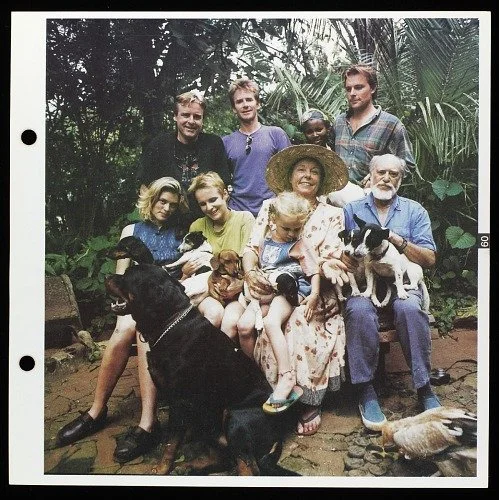
Then to Kenya in 1970, where the family lived in a converted double-decker bus in the tea fields of Limuru, north of Nairobi, surrounded by animals. There were wolfhounds, labradors, porcupines, and golden-rumped elephant shrews. But Anselm’s particular favourites were birds. He raised a pair of Egyptian vultures, one of whom lived to the extraordinary age of forty-five. He kept a flock of owls, a spotted thicknee called Otto, and an ostrich named EatEat, because that is what she did. His most beloved was Bird, an eponymous crested crane who moved with the family when they relocated to the Kitengela plains in 1979 and eventually met a lady crane in the wild. Bird proceeded to populate the plains with offspring, which can still be seen there today.
In 1972, Harvey co-founded the Amboseli Elephant Research Project with the American scientist Cynthia Moss in Amboseli National Park in the south of Kenya. It would become the longest continuously running elephant research project in the world, tracking over 2,500 individual elephants across more than five decades. From 1972 to 1976, Harvey lectured in the Zoology Department at the University of Nairobi and supervised graduate students in conservation biology. He later served as ecologist on a major wildlife management project for UNEP, FAO, and the Government of Kenya. His final posting was as Assistant Executive Director of the United Nations Environment Programme, responsible for global environmental monitoring and assessment. He wrote and edited several books, including “Pyramids of Life” with the photojournalist John Reader, “The Great Wildebeest Migration” with photographer Carlo Mari, “Africa for Kids,” and the 2011 compendium “The Amboseli Elephants: A Long-term Study of a Long-lived Mammal,” co-edited with Cynthia Moss and Phyllis Lee.
Through all of it, the camera was never far. On his own website, croze.net, Harvey describes himself as “a third-generation photographer,” though he was counting forward, not back. Harvey Senior was the first generation. Harvey was the second. The third was a space he was leaving for his grandchildren to fill: myself and Talu, both photographers. Harvey’s work focuses on nature, real and abstract. “Growing up in my father’s darkroom I learned photography by osmosis, you might say.” His galleries include Amboseli elephants, Karura Forest, infrared photography, and abstract colour explorations. He has, in his own words, come back to photography. Perhaps he never really left.
In 1979, the family moved to the Kitengela plains on the edge of the Nairobi National Park, settling on a piece of land on the Kiserian Gorge. It was pretty wild. There was just one tree. Lions prowled at night. Harvey and Nani built towers whose ladders they could pull up after dark, then mud and thatch huts. Nani planted hundreds of trees beneath which Anselm and his siblings would play with their pets: a zebra, a duiker, various dogs, snakes, and birds.
Nani began working with stained glass. In 1981, she founded the Kitengela Stained Glass Studios. Over the following decades, she transformed the barren Kitengela plot into something visitors would later describe as “Flintstones meets Gaudi”: a sprawl of organic, multicoloured buildings with stained-glass windows sparkling in the sunshine, wildly imaginative mosaic-covered creatures rising from the landscape, dragons and sculpted birds with glass-adorned wings. She built a suspension bridge from steel lift cables and decorated it with recycled glass, spanning a deep river valley thirty metres below. The property became a landmark, a destination, a world unto itself.
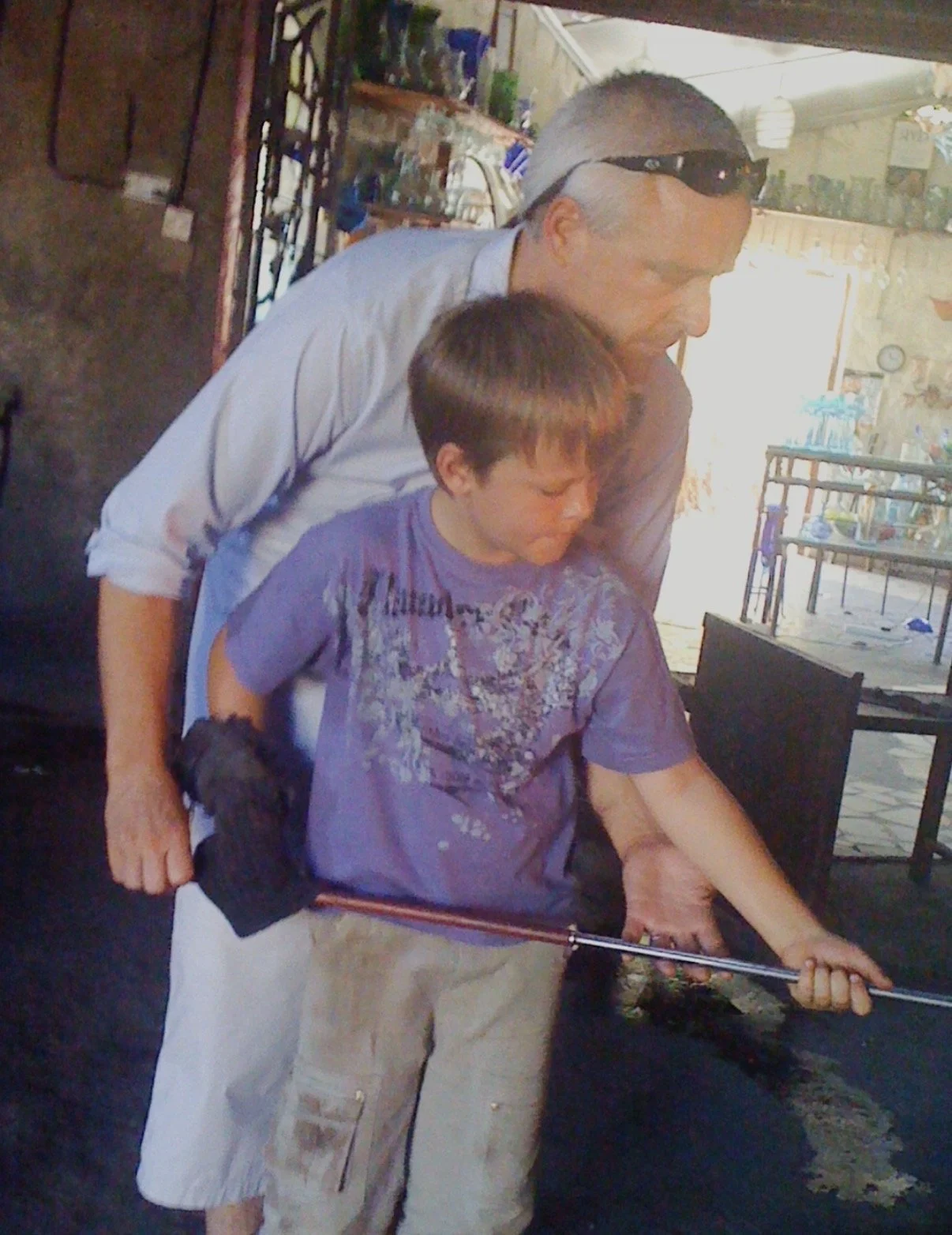
Anselm, surrounded by all of this, absorbed the creative instinct the way his father had absorbed photography in a darkroom in Michigan. Nani encouraged him to learn about molten glass so she could have flat glass for her stained glass business. After a business degree, Anselm went to France for a short glassblowing course with Willem and Bernard Heesen, who then invited him to Holland for a longer apprenticeship at the Oude Horn glass studio. He sweated, made coffee, blew sample bubbles, and pestered Bernard with a million questions about every aspect of making glass. He fell in love with the process. “It is incredibly difficult to do,” he said later. “It is very magical to watch, it is also very magical to do, it is meditative. You have to be incredibly focused. It is very skill heavy, so it takes years and years to learn how to do it well and properly, and you never know completely how to be an expert.”
All fired up, he came back to Kenya in 1991 and founded Kitengela Hot Glass (https://www.kitengela.glass), East Africa’s first glassblowing company. There was no mains electricity on the Kitengela plains. With a Finnish glassblower and inventor named Mikko Merikallio, who had a soft spot for Kenya, having originally disembarked from a merchant liner in Mombasa in the mid-1970s, Anselm devised a unique steam-injected system using recycled engine oil to heat the furnaces and melt the glass. A space was cleared and building started. He based the design of his main studio on the Red House Cone, an old English glass beehive from around 1800, and built an iconic dome studded with glass stars mapped to the constellations of the day. It took about four years. He sold goblets to buy the bricks to build it. By the time it was finished, one studio had evolved into many: glass blowing, lighting, metal, dalle de verre, beads, and funky fencing. The local masons who had been building the studios needed jobs when the construction was done, so they were engaged as the first apprentices. That is how Kitengela Glass got started. Everybody dived in and learned together.
Today, more than thirty years later, Kitengela Hot Glass employs over a hundred people. Every single product is made from one hundred percent recycled glass, salvaged from the local building industry. Five hundred kilograms is melted every day using steam power and recycled engine oil. No two glasses are the same. Anselm creates custommade pieces, bespoke installations, chandeliers, tableware, jewellery, windows, murals, mosaics, furniture, and whole walls. The property is now a destination with a cafe, accommodation, glass-blowing demonstrations, a gallery of Nani’s artwork, and the famous scary bridge. People come from all over the world.
And then there’s me, Taro. Born and raised in Nairobi, between two households, surrounded by glass and art and wildlife and cameras. A childhood on the Kitengela plains where crested cranes descended from a bird my father raised by hand. A mother who teaches. A father who bends molten glass into shape.
My story moved through Hong Kong, where the culture was intoxicating even when the city was overwhelming. Through luxury safari camps in Kenya, where guiding tourists past lions gave way to photographing every animal that held still long enough. Exploring eastern and southern Africa. Through a year in England and a bakery. And eventually, to the other side of the world entirely: the Gold Coast of Australia.
The camera is different now. The Leica has given way to a Lumix. Film has given way to digital. But film has not been abandoned. There is still a roll of 35mm in the bag. The same format Harvey Senior shot on. The same grain. The same patience.
Four generations. Same mission. Create and capture.
Their attention to detail and commitment to quality truly stood out. We’ve already recommended them to others.
—Former Customer